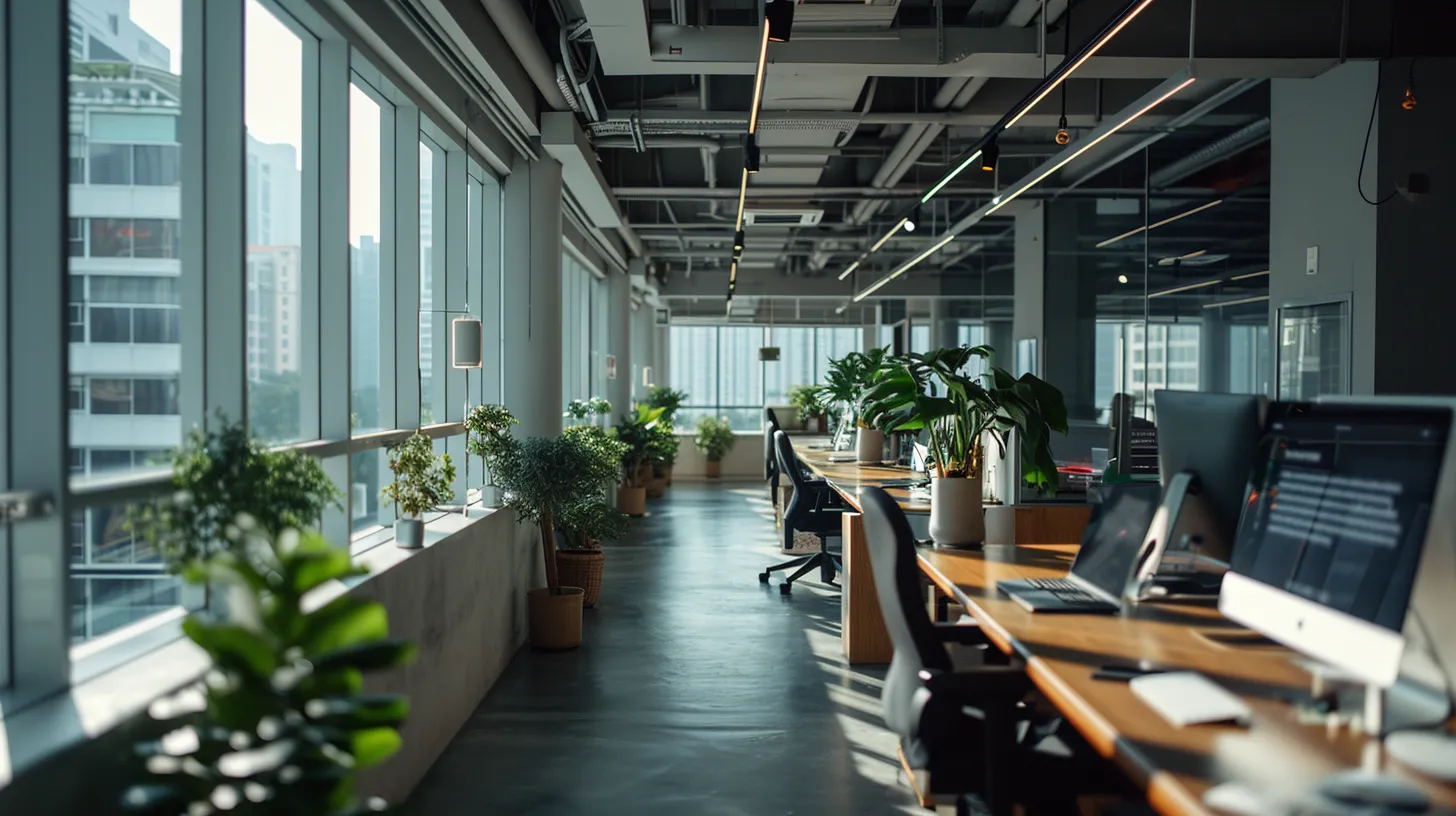
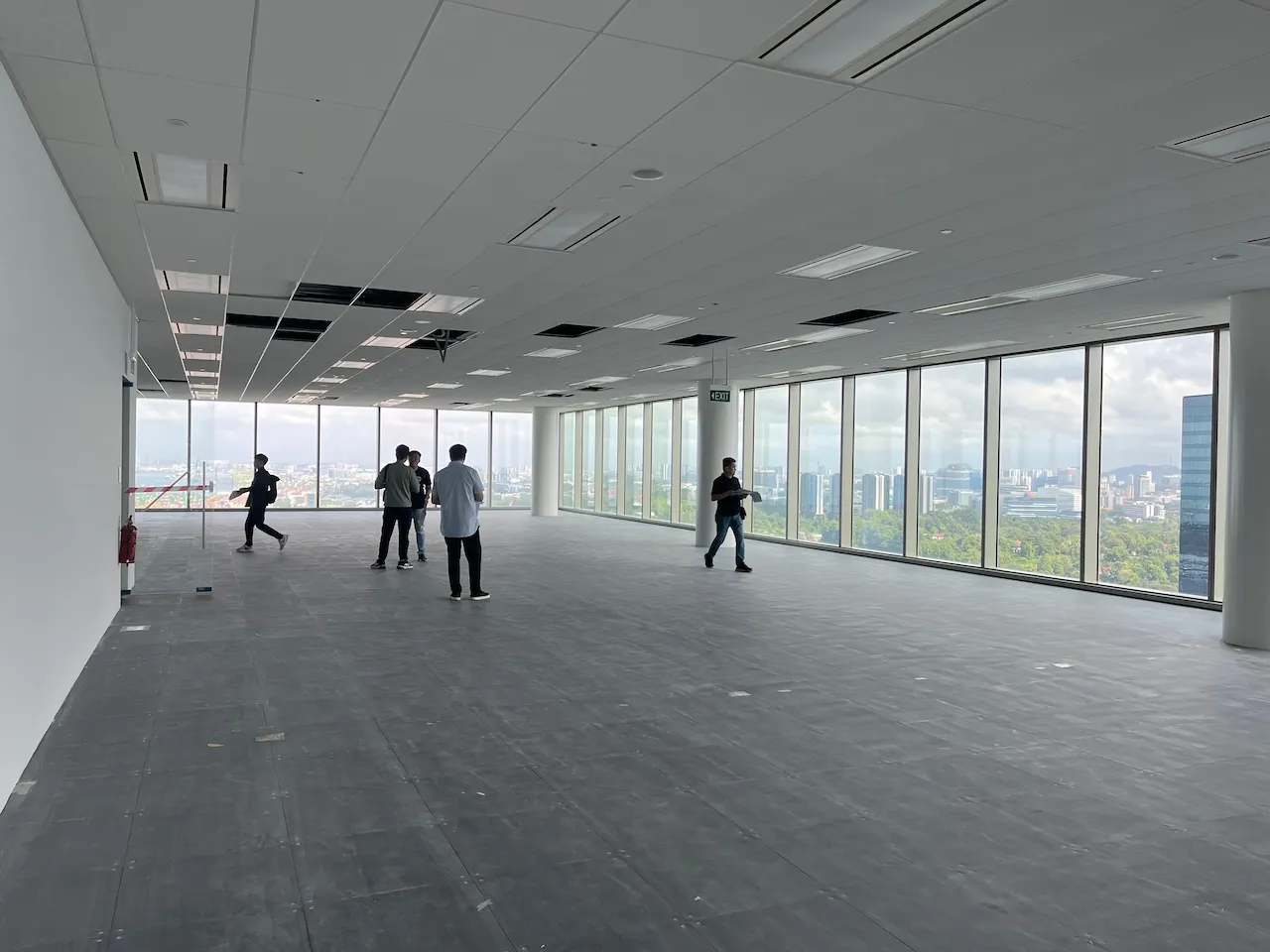
The short answer: 80 to 150 square feet per person, depending on your industry, work style, and how much space you allocate for meeting rooms, pantry, and common areas.
But that range is massive — it could mean the difference between a 4,000 sqft office and a 7,500 sqft office for a 50-person team. That's potentially $20,000+ per month in rent difference.
The quick formula
Here's the simple calculation:
Total Office Space = (Number of Employees × Sqft per Person) × Circulation Multiplier
For example:
30 employees × 120 sqft = 3,600 sqft
Add 15% circulation: 3,600 × 1.15 = 4,140 sqft
But "sqft per person" varies wildly. Here's what the numbers actually look like by industry.
Partner offices, large meeting rooms, document storage
Tech & Startups
80–120 sqft
Open plan, hot-desking, collaborative spaces
Trading & Sales
80–100 sqft
Dense open floor, minimal private offices
Corporate HQ
150–200 sqft
Executive suites, boardrooms, reception areas
General Commercial
100–140 sqft
Mix of open plan and enclosed offices
Key insight: The more client-facing and senior your team, the more space per person you'll need.
[[hr]]
Space per person by work style
Go tight or go spacious? That depends on your company's work culture.
Your company culture matters more than industry benchmarks:
Open Plan Office — 70–100 sqft per person
Everyone sits in an open floor with minimal partitions. Great for collaboration, tight on privacy. Common in tech companies and startups.
Traditional Office — 120–150 sqft per person
Mix of private offices for managers and cubicles or workstations for staff. Standard for professional services, finance, and established corporates.
Hybrid Workspace — 50–80 sqft per person
Not everyone is in the office every day. Hot-desking, shared workstations, and bookable meeting rooms. Requires fewer desks but more collaboration spaces.
Executive-Heavy — 150–200 sqft per person
Multiple private offices, large boardrooms, reception area, and dedicated spaces for senior leadership. Typical for law firms, investment firms, and regional HQs.
[[hr]]
Don't forget common areas
The "sqft per person" numbers above are just for workstations. You also need to budget space for:
Area
Typical Size
Small Meeting Room (4 pax)
100–120 sqft
Medium Meeting Room (8 pax)
180–220 sqft
Boardroom (12+ pax)
300–400 sqft
Pantry / Breakout
150–300 sqft
Reception
100–200 sqft
Server Room
50–100 sqft
Storage
50–150 sqft
Rule of thumb: Add 1 meeting room for every 8–10 employees.
[[hr]]
The circulation factor
Raw workspace calculations don't account for corridors, walkways, and access paths. You need to add a circulation allowance:
12% — Very efficient layout, minimal corridors
15% — Standard office layout (most common)
20% — Complex layout with multiple zones, or irregularly shaped floor plate
If your floor plate has columns, odd angles, or multiple entry points, go with 20%.
[[hr]]
Real example: 50-person Tech company
Let's calculate for a tech startup with 50 employees:
Workstations:
50 employees × 100 sqft = 5,000 sqft
Common Areas:
5 meeting rooms (various sizes) = 700 sqft
Pantry/breakout zone = 250 sqft
Reception = 150 sqft
Server room = 80 sqft
Subtotal: 6,180 sqft
Add 15% circulation: 6,180 × 1.15 = 7,107 sqft
This company should be looking at offices between 7,000–7,500 sqft.
[[hr]]
Real example: 20-person Law firm
Now let's calculate for a law firm with 20 employees (5 partners, 10 associates, 5 support staff):
Workstations:
5 partner offices × 200 sqft = 1,000 sqft
10 associate offices × 120 sqft = 1,200 sqft
5 support workstations × 80 sqft = 400 sqft
Common Areas:
1 boardroom = 350 sqft
2 meeting rooms = 300 sqft
Reception = 200 sqft
Pantry = 150 sqft
Filing/storage = 200 sqft
Subtotal: 3,800 sqft
Add 15% circulation: 3,800 × 1.15 = 4,370 sqft
This firm should target offices around 4,500 sqft.
[[hr]]
Singapore-specific considerations
Grade A vs Grade B
A good Grade A office offers more than just a prestigious address
Grade A offices in the CBD (Marina Bay, Raffles Place, Tanjong Pagar) typically have:
Efficient column-free floor plates
Better natural light distribution
Higher ceilings (more spacious feel)
You might get away with slightly less sqft per person in a well-designed Grade A building compared to an older Grade B building with awkward columns.
Lease Terms
Most Singapore office leases are 3 years. Plan for growth:
If you're at 50 people and expect to hit 70 in 3 years, size for 60–65 now
It's cheaper to have 10% unused space than to break a lease early
MOM Requirements
Singapore's Ministry of Manpower doesn't mandate minimum office space per employee, but building management may have occupancy limits based on fire safety calculations. Check with your landlord.
[[hr]]
How to calculate your space needs
You could do the math yourself, or use our free calculator that calculate your exact requirements:
Kenneth Poh created RightSpace after serving as CEO of a Design & Build firm. This guide draws from real projects, real budgets, and practical insights gained from real client experiences.
FAQs
How much office space per person in Singapore?
The standard is 100–150 sqft per person for most businesses. Tech companies and startups often work with 80–100 sqft, while professional services firms typically need 150–200 sqft per person.
What is the minimum office space per employee?
There's no legal minimum in Singapore, but practically speaking, 70 sqft per person is the absolute minimum for a functional workspace. Below that, the space feels cramped and productivity suffers.
How many employees can fit in 1,000 sqft?
With standard office density (100–120 sqft per person), you can fit 8–10 employees in 1,000 sqft. For a dense open-plan layout, you could fit up to 12–14 people.
How do I calculate office space for 50 employees?
Multiply 50 by your target sqft per person (typically 100–150), then add 15% for circulation. For a standard office: 50 × 120 × 1.15 = 6,900 sqft.